
Quick answer
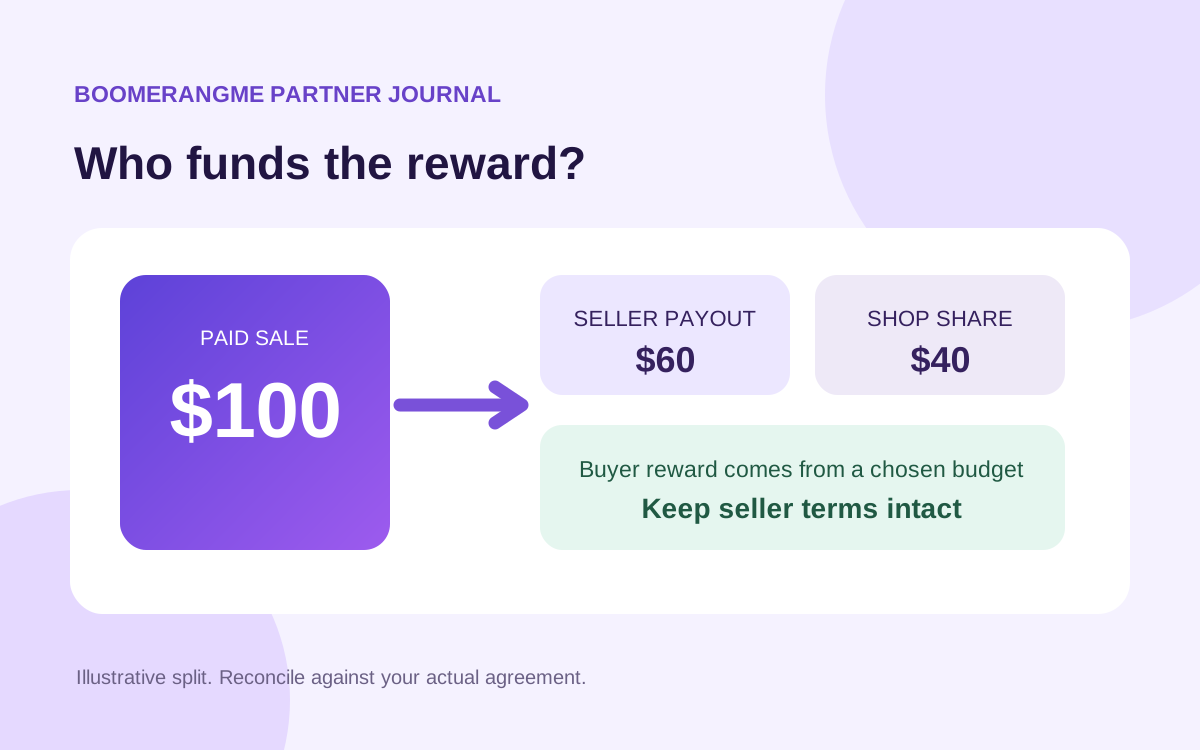
A consignment shop can reward a repeat buyer, but the reward must not quietly reduce a seller's agreed payout. Start with the consignment agreement and the completed-sale receipt. Decide whether the shop pays for the reward from its own commission, whether particular stock is excluded, and how a return unwinds the buyer's progress.
Separate the buyer relationship from stock ownership
Shopify's consignment inventory guide explains that a supplier or consignor retains ownership until an item sells and that sale, return and payout records belong with the agreement. A loyalty card does not replace that ledger. It shows the buyer a benefit; the store still needs an item-level record of whose stock sold and what it owes the consignor.
Consider a hypothetical jacket priced at $100 with an agreed $60 seller payout. If the shop gives a $10 future reward funded from its own share, its gross share before other costs falls from $40 to $30. If staff simply subtract the reward from the sale proceeds before calculating the split, the seller may unexpectedly bear part of the promotion. The figures are illustrative, not a recommended split or profitability estimate. Write the funding rule into your offer and reconcile it against actual agreements.
Choose an earning rule that staff can explain
A visit stamp avoids item-level price calculations, but one customer could earn progress by browsing without buying. An eligible-spend rule ties progress to a completed sale, yet mixed baskets complicate it. A simple pilot might award one stamp for a paid, unreturned purchase over a stated threshold, regardless of item count. Another shop might include only shop-owned accessories in spend-based points until its consignor contracts explicitly address buyer incentives.
Put the exclusions on the sign-up page and receipt. Gift-card purchases, deposits, taxes, shipping, markdowns and consigned items may need different treatment. Do not assume a card setting can infer those categories from a cash-register total. The retail loyalty guide explains the wider margin question; the rule here is that buyer progress and seller payout must reconcile to the same completed transaction.
Handle returns before you issue rewards
A returned consigned item may trigger a refund, reverse a seller payout, or require a later adjustment under the agreement. The buyer's earned progress also needs a clear correction rule. Save the sale reference, item identifier, consignor identifier, original reward entry and reversal reason. If the buyer has already redeemed a reward, avoid silently creating a negative balance without a published policy and a staff review.
For example, if a buyer purchases two items and returns one, recalculate eligibility using the kept item and the actual refund. If your program awards a single qualifying-visit stamp for any kept eligible purchase, the stamp may remain. If the only qualifying item was returned, reverse it. The returns and exchanges guide covers the customer-facing explanation; the consignment ledger determines the seller side.
Pilot with a receipt-level checklist
Choose one shop location, one reward and a short evaluation period. At checkout, staff confirm that the sale is settled, mark the eligible amount or visit once, and store the receipt number. During reconciliation, compare reward entries with completed receipts and flag exceptions: partial refunds, disputed item condition, split tender, gift-card payment and chargebacks. Measure redemption cost against the shop's retained share, not the full ticket price.
Boomerangme documents reward cards and stamp cards. You can explore Boomerangme as a customer-facing card, while keeping consignor ownership, payout and return accounting in your actual sales system. This guide does not claim a native integration with consignment software. Test your edge cases before enabling any automated earning rule.
Quick questions
Should a consignor's own purchase earn loyalty progress?
Use the same buyer eligibility rule unless the person's consignor agreement creates a separate treatment. Do not mix a seller payout with a buyer reward balance.
Can a reward discount reduce a consignor's payout?
Only if the agreement clearly allows that calculation. A safer starting point is to fund the promotion from the shop's own share and review the resulting margin.
What happens when a consigned item is returned?
Reconcile the item return and seller payout first, then correct buyer progress using the original receipt and your published return policy.
Sources & further reading
- Consignment inventory: what it is and how it worksShopify's 2026 explanation of ownership, sale records, returns and consignor payouts; checked October 20, 2026.
- Boomerangme reward card documentationPrimary product documentation for reward-card mechanics; checked October 20, 2026.
- Boomerangme stamp card documentationPrimary documentation for visit or purchase stamps and limits; checked October 20, 2026.
Sources reviewed .
Numerical examples are illustrative unless a cited source states otherwise.