
Quick answer
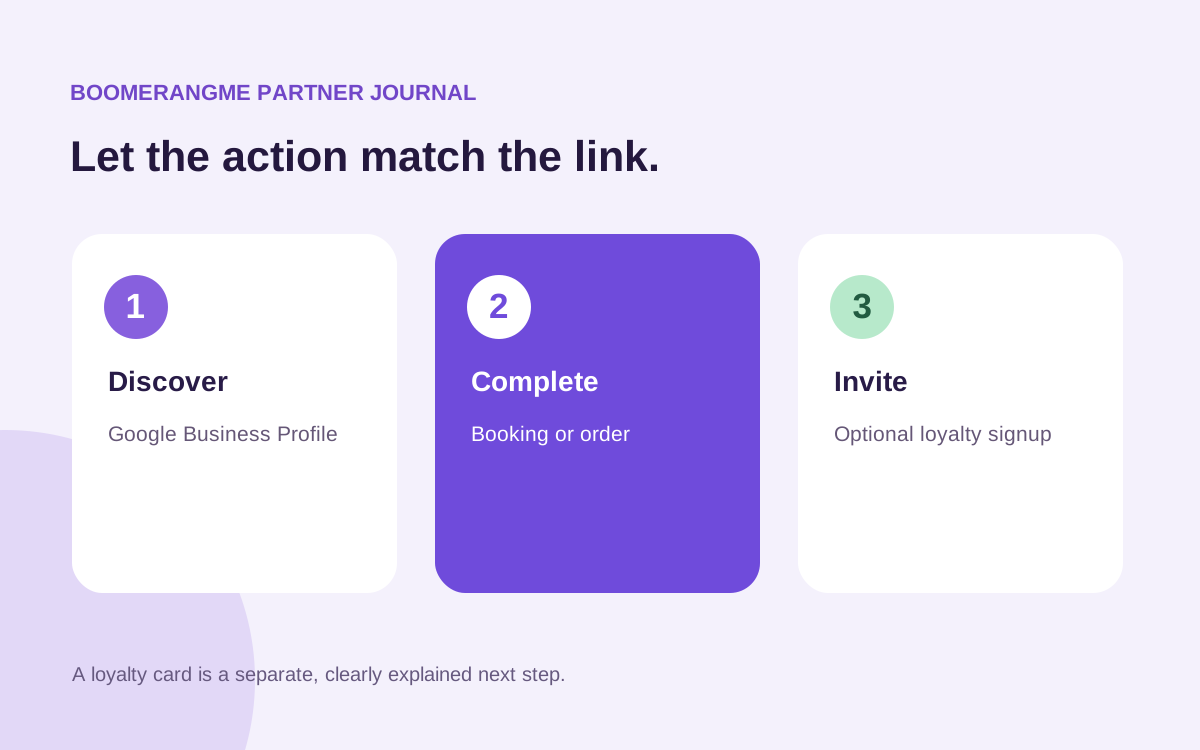
A local business should not use a Google Business Profile booking or ordering action link as a shortcut to an unrelated loyalty signup. Google's policy says the designated action must be completable on the linked page: an order link must allow an order, and a booking link should lead to a bookable service. A loyalty invitation can still be part of the customer's journey through the business website, at the right point and with a clear explanation.
Match the Google link to its promise
Google's business links policy requires a dedicated page for the business and, for multi-location companies, a page for the specific location. It also says action links must permit completion of the named action and rules out social sites, messaging links, app-store links and link shorteners for those links. Eligibility differs by business type and region. A hair salon may be eligible for booking but not online ordering, for example.
Therefore, a 'Book' action should open the salon's actual appointment path, not a standalone digital loyalty card registration form. A restaurant's 'Order' action should permit an order. This is a reading of Google's published policy, not a guarantee about approval of any particular profile or URL. If the action link changes, test it on mobile and watch for broken redirects.
Place loyalty after the core action or on a suitable website page
A business website can explain the loyalty program where it is relevant: after a booking confirmation, alongside an order confirmation, on a receipt page, or on a plainly labeled loyalty page linked within the site. Keep customer consent and the offer terms separate from the core transaction. A customer who came from Google to book a haircut should be able to finish the booking before being invited to save a repeat-visit card.
Imagine a two-location salon. The first location's booking button goes to its own appointment page. After a successful booking, the confirmation page may invite the customer to join a clearly described loyalty offer for eligible future appointments. The second location should not send customers to the first location's calendar. If the same card works across both branches, explain where it can be earned and redeemed. The multi-location loyalty guide helps with that rule.
Test the path as a customer would
Use a phone and begin at the public profile. Tap the website link and every available action link, confirm the destination and complete a harmless test of the intended action without submitting a real order. Confirm that a card signup page states what customers earn, when a reward becomes available, any exclusions, and how to get help. The QR signup guide covers the friction after a customer lands on the signup form.
Google says it checks action links and may remove links it cannot verify. Its policy explains that a destination should be accessible to automated crawlers, return a successful status and avoid CAPTCHA or access blocks. A loyalty landing page should also be usable and accessible to people, but do not infer that a page's mere existence creates a special Google loyalty action. Ask what link types the current profile actually offers.
Keep measurement honest
Add campaign tags only where they do not break the destination or obscure the final action. Record the visit, signup and later transaction separately. A website visit is not evidence that someone enrolled, and an enrollment is not a repeat purchase. The attribution guide explains how to avoid counting the same conversion twice.
Boomerangme documents digital stamp cards that a business can evaluate as the loyalty step after its website action. You can explore Boomerangme to test card signup and staff redemption. This guide does not claim a Google Business Profile integration or promise a particular Google link placement.
Quick questions
Can I make a Google booking button open only a loyalty registration form?
Google requires the link to complete the designated booking action. Use a real booking page and introduce loyalty in a relevant step around that journey.
Does every Business Profile support the same action links?
No. Google says eligibility varies by business and region. Check the options on the verified profile and the applicable policy.
Will a loyalty signup page on my site be crawled automatically by Google?
The action-link policy concerns Google's verification crawlers. Normal search indexing is a separate process and is not guaranteed by adding a site page.
Sources & further reading
- Google Business Profile business links policiesPrimary Google policy for action completion, location-specific landing pages and crawlability; checked October 20, 2026.
- Manage your local business linksPrimary Google help for supported link types; checked October 20, 2026.
- Boomerangme stamp card documentationPrimary product source for customer-facing loyalty card; checked October 20, 2026.
Sources reviewed .
Numerical examples are illustrative unless a cited source states otherwise.