Google Wallet Loyalty Pass Updates: Update Versus Patch
A class can affect many passes; an object represents one holder. Choose full update or partial patch with the blast radius in mind.

Product updates, industry signals, events, and video commentary. Understand the news before deciding what it means for your business.
Start with your business, or the question on your mind.
A class can affect many passes; an object represents one holder. Choose full update or partial patch with the blast radius in mind.
Not every trigger applies to every card. Build the test around the documented balance or reward event before enabling a workflow.
A “sleeping” customer in a café may be perfectly on schedule for a dental clinic. Set intervals from the real purchase cycle.
A sent message is not necessarily displayed. Installation status, wallet settings, browser support and device limits affect delivery.
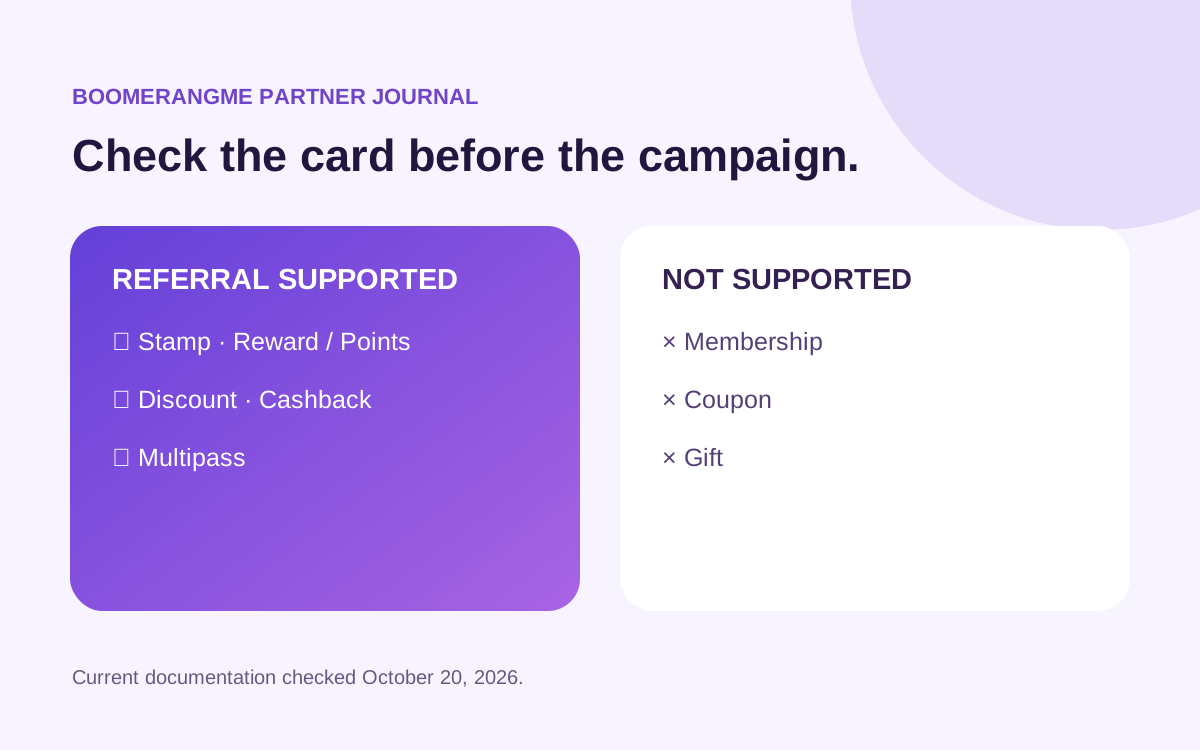
A share button and an eligible referral reward are different. The documented card-type list excludes membership, coupon and gift cards.
More places to earn rewards also means more questions about when those rewards become spendable.
A future loyalty change needs more than one launch headline when different benefits start on different dates.
The successful order is only half the test: a usable cashback integration also needs a clear cancellation and refund routine.
A new neighborhood targeting feature raises a useful question: did a restaurant buy a first visit or build a repeat habit?
A new corporate strategy connects tailored customer offers with menu execution, staff support and restaurant reliability.
A dated cruise loyalty launch offers a useful lesson: spending a reward should not automatically erase a customer’s recognition.
“Once a week” can mean two different things. Check when access resets before promising a recurring reward.
The Canadian transition highlights three promises worth making clear: what changed, what value remains, and what customers need to do.
Google Wallet provides an established route for storing loyalty passes. A current documentation date is not proof of a new feature launch.
A loyalty offer should be understandable from the customer’s side: what do I earn, how do I qualify, and can I realistically use the benefit? ABC News’ loyalty-rewards discussion provides consumer-facing context. For a US local business, use it as a prompt to check those questions before adding more promotional messages.
AI-assisted shopping makes accurate benefits and exclusions more important. The June update is a reason to check your rules, not assume every loyalty tool is connected.
Progress and access can give a program purpose. Start with one behavior you can track, a reward people understand, and a test that includes the cost.
The published May agenda linked loyalty, AI discovery, and measurable growth. These are useful evaluation questions even without an enterprise loyalty team.
Starbucks’ 2026 US rewards announcement introduced three membership levels. For an independent café, the useful lesson is to check whether a tier adds a clear, affordable benefit that customers can understand. A national chain’s structure is a case to examine, not a template every local business needs to copy.
The August launch gave rewards members an earlier window for a new item. For a local business, the lesson is to make membership useful through real access.
The current help guide describes behavior-based push notifications and a control group. Here is what those details mean for an owner evaluating automated retention.
Try a broader topic, or choose “All”.
Explore Boomerangme’s digital wallet cards and engagement tools. See the current features, plans, and sign-up options on the official website.