
Quick answer
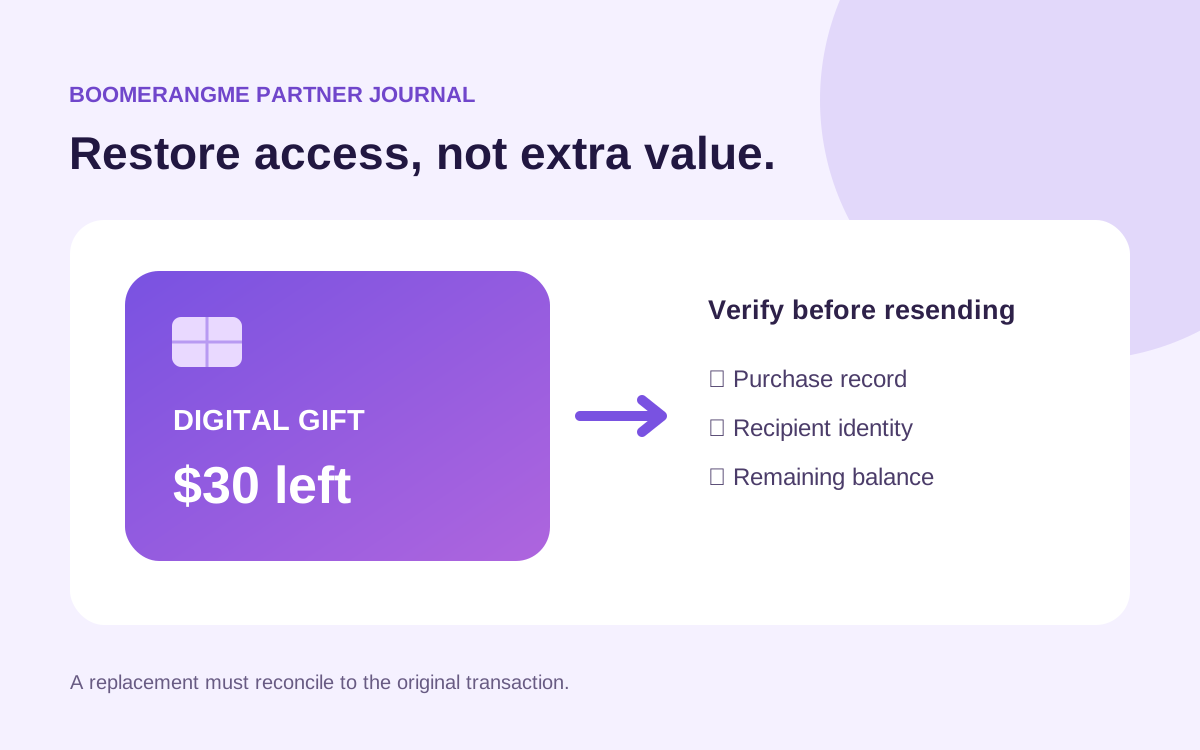
When a customer loses a digital gift-card link, staff should help them regain legitimate access without creating a second spendable balance. The safe starting point is the original purchase record, the card status and the transaction history. A screenshot of a balance alone does not establish ownership or whether the card has already been used.
Start with a support ticket, not a replacement card
Ask for a purchase receipt or order reference, approximate purchase date, purchaser or recipient contact details and the last known balance. Avoid requesting the complete card number or other sensitive information in a public message. Compare the details with the merchant's payment and issuance records. If the purchaser and recipient differ, determine which party your written terms authorize to request access or a replacement.
The FTC's gift-card advice urges consumers to retain card and receipt information when reporting a scam. The FTC guidance is about consumer fraud, not a technical instruction for your specific card platform. It reinforces a practical point for merchants: a purchase reference and transaction trail matter when a customer disputes use.
Reconcile the value before restoring access
Record the issued value, any payments, redemptions, refunds, adjustments and remaining balance. Check whether another device or customer profile has the same card attached. If the card was forwarded to someone else, do not assume that the latest person who contacts you is the authorized recipient. A support worker needs a documented path for escalating a disputed transfer.
Consider a hypothetical $50 card with a $20 redemption. The remaining value is $30, not a new $50 entitlement. If staff issue a fresh $50 card merely because the link is missing, the shop may create $80 of usable value. A replacement process should either securely restore the existing card or invalidate and reissue only the verified remaining amount, with a traceable link between the old and new records. This is an operating recommendation, not a claim that every platform has an automatic replacement feature.
Treat suspicious use separately from ordinary access help
If a customer says a card was used without permission, preserve the transaction reference and temporarily follow your dispute procedure. Ask who had the link, whether it was shared, and when the customer last saw the balance. Do not promise a refund or instantly remove another person's transaction before the facts are checked. Escalate payment disputes to the proper payment provider when necessary. Terms and applicable consumer rules vary across the United States, Canada, the United Kingdom and Australia; use locally reviewed terms rather than copying another merchant's policy.
A staff adjustment should name the staff member, timestamp, reason, related transaction and customer communication. The manual adjustments guide shows how to keep that trail. If duplicate customer profiles are involved, consult the duplicate-record checklist before merging anything.
Test the help process before the holiday rush
Create a test card, issue it to an internal test recipient, redeem part of its value and simulate a lost link. Confirm exactly what the holder sees, what staff can see, what identifiers support can use, and how a replaced or restored card behaves after a second redemption attempt. Ensure the receipt explains where the buyer can get help without publishing gift-card credentials.
Boomerangme documents gift cards and a customer gift-card profile that includes balance adjustments. You can explore Boomerangme and test its current support controls with your own gift-card terms. Do not infer a fraud guarantee or replacement workflow from the existence of a balance field.
Quick questions
Should I resend a lost card link to anyone who knows the recipient's name?
No. Use the purchase record and your documented identity check, particularly when the remaining balance has value.
Can I issue a full-value replacement after partial redemption?
That would create more usable value unless the old card is invalidated and the remaining amount is reconciled. Trace the old and new records.
What if the card holder says a redemption was fraudulent?
Preserve the transaction history, apply your dispute process and communicate the next review step without promising an unverified outcome.
Sources & further reading
- Avoiding and reporting gift card scamsUS FTC consumer advice about preserving card and receipt details and responding to fraud; checked October 20, 2026.
- Boomerangme Gift cardPrimary description of the digital gift-card type and balance display; checked October 20, 2026.
- Boomerangme customer gift-card profilePrimary documentation for customer profile and direct balance adjustments; checked October 20, 2026.
Sources reviewed .
Numerical examples are illustrative unless a cited source states otherwise.